1. Chile Report: Salmon Farming
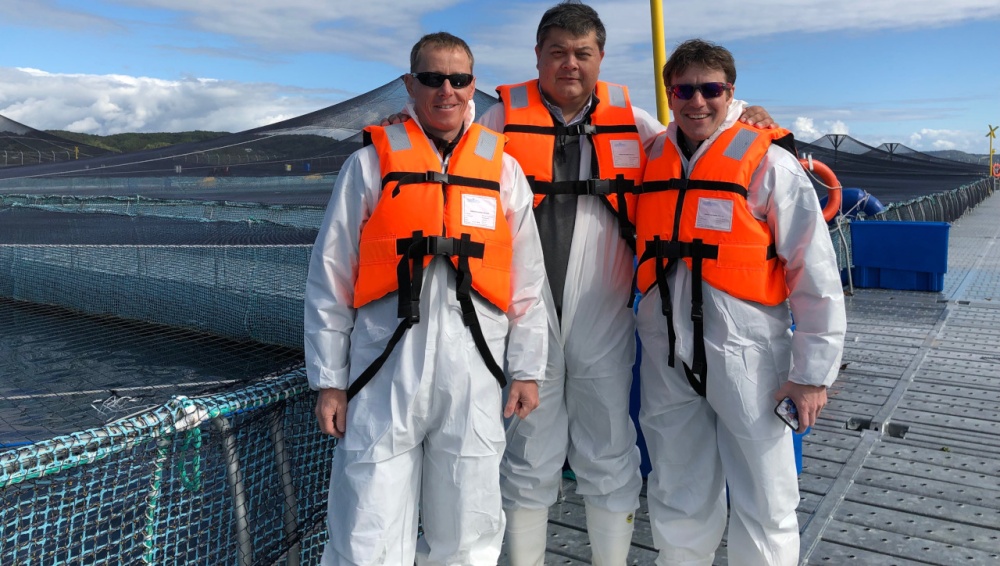
At the beginning of 2019, we took the opportunity to visit salmon farming operations in the Chilean summer.
About a year ago, the topic of “forever chemicals” (PFAS) began to become a recurring theme in the Swiss media. Initially, fish from Swiss lakes that appeared clean were singled out for criticism due to government bans. By now, many people are likely aware that PFAS residues can be found practically everywhere—in water and a wide range of foods. The priority of removing PFAS from the environment as quickly as possible has long since been abandoned. Instead, the focus is now on building resilience in our water systems and food production. At Bonafide, we have addressed this topic in depth as part of our risk management processes. It may come as a surprise, but salmon from Norway and wild fish from the ocean have a very low risk of accumulating PFAS at all.

Citation from «scnat, swiss academy of sciences»: PFAS are a large group of synthetic chemicals found in a wide variety of applications. Because they are very stable and persist in the environment for centuries, they are colloquially referred to as “forever chemicals.” Today, they can be detected virtually everywhere in nature and in every human being. Many PFAS and/or their degradation products are harmful to both humans and the environment. The steadily rising concentrations and the associated risks can only be prevented through a gradual, coordinated phase-out of PFAS use and the reduction of existing contamination.
You can find more basic information about PFAS in this fact sheet from scnat (in German only):

These man-made, harmful chemicals end up in the environment, where they remain “forever.” Scientists already confirm that we will likely never be able to remove PFAS from nature - unless we turn the entire planet upside down and filter the soil and water. Accordingly, we will have to live with them and manage them by establishing PFAS-resilient processes. The focus is on the concentration levels of these chemicals, with regulators setting limits that must be adhered to.
For humans, animals, and plants alike, exposure occurs through water and food. As is well known, fish swim in water, and carnivorous fish eat smaller fish, causing them to accumulate PFAS more quickly. This is similar to what we know about heavy metals in wild fish that swim in the ocean. Fortunately, PFAS levels in the world’s oceans are not high enough to be a problem. However, wild fish from lakes in densely populated regions or areas with industrial activity - where PFAS enter the water - can exceed the limit values by a wide margin. For example, in November 2025, the canton of Zug introduced a ban on the sale and distribution of pike and perch from Lake Zug.

To find out where these “forever chemicals” are hiding, there’s only one thing to do: test, test, and test again. Switzerland, at least, seems a bit slow on the draw in this regard compared to the EU or Norway. It wasn’t until November 2025 that the federal government and the cantons presented the results of a nationwide campaign on the presence of PFAS in animal-based foods. The result: In seven (0.8%) of 889 official samples, concentrations exceeded the legal limit. However, PFAS were detected in 220 samples - that is, in one out of every four food items tested. And this was found in meat, eggs, milk, cheese, and fish. Such tests for plant-based foods are still pending, but the samples taken so far from agricultural soils do not bode well.

As early as 2010, Norwegian authorities began testing their farmed fish for PFAS as part of their monitoring program. When we analyze the most recent monitoring program data available for 2024, we find that 264 samples were collected from farmed Atlantic salmon. PFAS were detected in only a single sample, and even then at a level 70 times below the maximum limit set by the EU. Farmed fish in Norway would have two ways of absorbing PFAS: through water or fish feed. Neither appears to be a cause for concern.

To understand why Norwegian salmon pose no problem with regard to “forever chemicals,” while there is a ban on fish from Lake Zug, the PFAS hazard map is helpful. It illustrates quite clearly where PFAS-contaminated areas can be found throughout Europe. It quickly becomes clear that pollution is highest in densely populated areas and industrial sites in particular. And with that comes a greater risk of ingesting PFAS through drinking water or local food. It’s only understandable that in Norway’s remote fjords, far fewer chemicals were used - for example, to extinguish wildfires. It’s also understandable that at Zurich Airport, the fire department regularly practiced extinguishing burning airplanes with PFAS-containing foam, thereby unknowingly contaminating the soil.
For now, there is no cause for concern regarding the consumption of wild-caught fish from the ocean: PFAS, which flows into the oceans via rivers, is likely to become so diluted in the world’s oceans that it remains harmless and does not accumulate to a significant degree.

In March 2026, we attended Oxyle’s “PFAS Forward Action Summit” in Zurich. This spin-off from ETH Zurich has developed a technology to filter these chemicals out of water. At the event itself, which was attended by scientists, government officials, and companies, the focus was understandably much more on natural capital (water and soil) than on end products (food). One of the presentations focused on Rastatt, a small German town between Strasbourg and Karlsruhe. There, groundwater was contaminated with PFAS due to the disposal of waste from the paper industry that was believed to be harmless. As a result, the local water utility had to shut down 3 of its 9 pumping stations and equip the others with filtration technology. This caused the cost of drinking water treatment to double. Anyone who now argues that the polluter should bear the costs is being a bit bold. At the time, no one had violated any applicable laws - since the dangers of “forever chemicals” apparently had not yet been researched. It would come as no surprise if, in the future, an increasing number of PFAS lawsuits against chemical companies or other polluters were to occupy our courts.
The cleanup effort - or rather, the development of PFAS-resilient systems - will also produce winners. On the one hand, these will be laboratories, whose testing volumes will increase. In response to political pressure, governments will have to tighten regulatory requirements for the food industry. On the other hand, as mentioned in the opening section, companies that offer water filtration solutions will benefit greatly.

The media frenzy surrounding “forever chemicals” is unlikely to subside. The idea of ingesting PFAS through drinking water and food is too emotionally charged, even though it has been a reality for several years - and is detectable in our own bodies. Authorities must strengthen consumers’ confidence in food safety inspections. The widespread belief that “local consumption is better” is likely to lose significance - safe products are what consumers demand. Companies or industries such as the salmon farming sector in Norway can help by increasing their own resilience to PFAS. For example, the raw materials used in animal feed are now also tested for PFAS, which builds consumer confidence. For investors in the food industry, “forever chemicals” should be classified as a potential risk, just like other toxins (such as mercury or pesticides). And risks must be actively managed by acquiring new knowledge, continuously monitoring companies, and ensuring that a robust investment process weeds out the bad actors.



Comments